


How close are we to a serious ice-throw incident in wind farms?


Wind power has become a cornerstone of the clean energy transition worldwide. Each new turbine brings us closer to a sustainable future. But like any large industrial system, wind farms are not without risks.
Turbines deliver renewable electricity, yet accidents and injuries do happen – and the data shows it. A recent global summary documented 5,737 wind turbine accidents to September 2024, including 240 fatalities and 671 injury incidents.
Most of those hurt have been wind industry or construction workers, but dozens of members of the public have also been injured in turbine-related accidents. These figures underscore a simple truth: when it comes to wind energy, safety matters just as much as performance.
The human side of wind farm accidents
Wind farm incidents range from routine maintenance mishaps to dramatic equipment failures. Some of the most notable accident categories include:
The reported incidents range widely:
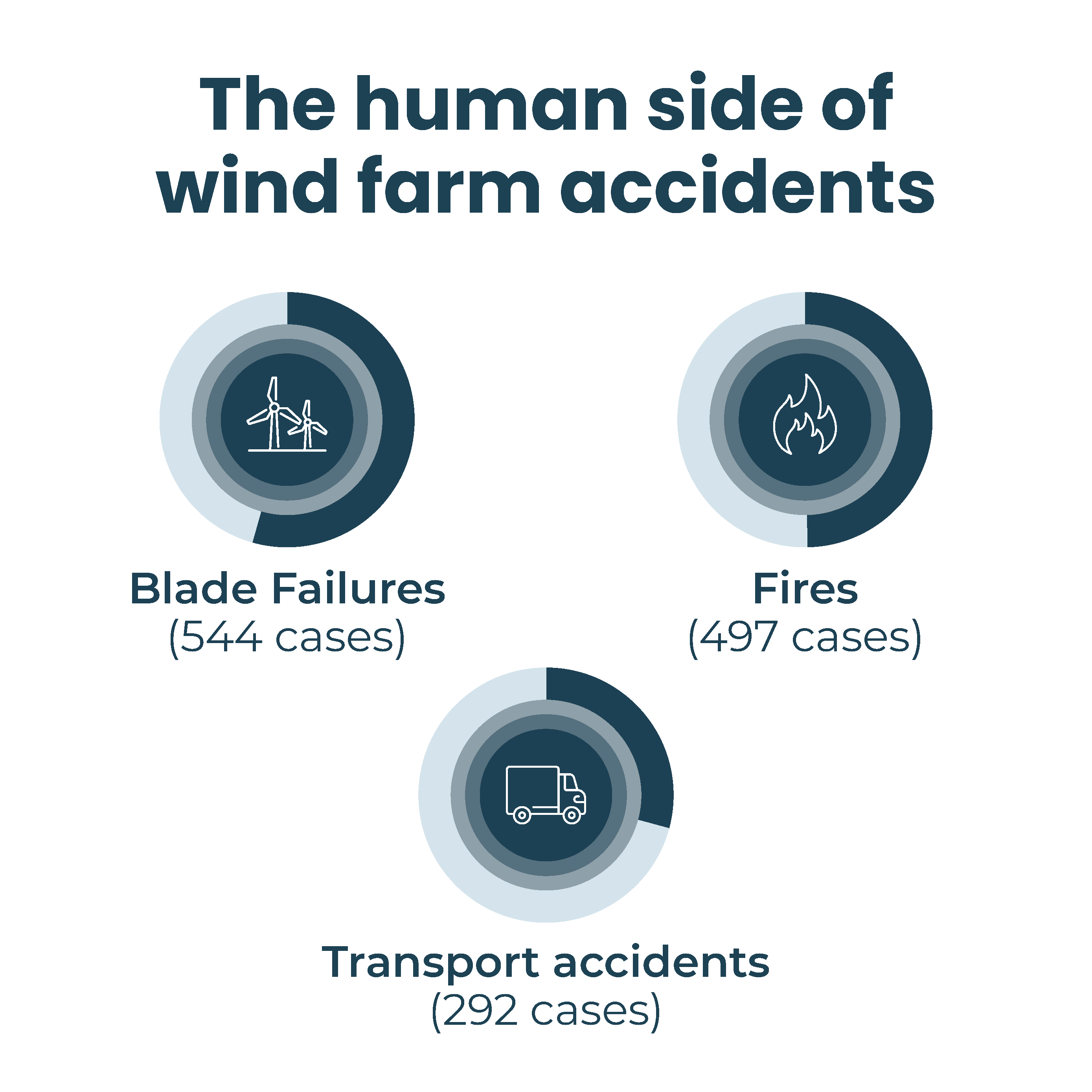
- Blade failures (544 cases) that sent debris hundreds of meters from the turbine.
- Fires (497 cases) where sparks and falling debris created hazards on the ground.
- Transport accidents (292 cases) during the movement of massive turbine parts.
These statistics remind us that wind farms, while clean and efficient, must constantly manage operational safety risks both for workers and for surrounding communities.
Ice throw: an underestimated threat
Among the many hazards, one stands out as both underreported and potentially serious: ice throw. In cold climates, ice can build up on turbine blades during winter storms or freezing fog. When the blades start spinning again – or even as the sun warms the ice – those chunks can loosen and be flung a considerable distance. Field data shows ice fragments from turbines can be hurled up to 140 meters away (nearly the length of a football field).
The danger is not just how far ice can travel, but the force it carries. Safety studies indicate that a relatively small piece of ice can pack a punch: roughly a 200-gram fragment falling from 30-50 meters can hit the ground with about 40+ joules of kinetic energy. That’s on the order of a hard-thrown baseball, easily enough to cause a serious head injury or worse.
The 2024 accident report documents 47 cases of ice throw, but here’s the surprising part: there are no publicly reported injuries in Europe directly attributed to it. Does that mean there’s no risk? Not at all.
Why “No reported injuries” doesn’t mean no risk
Wind industry incident data is known to be incomplete – some experts suggest that well under 20% of accidents ever get recorded in public databases. For example, one insurance analysis found an average of 50 turbine fire incidents per year, more than double what was publicly reported, implying many events go uncounted. In the case of icing, a 2003 study tallied 880 ice throw events in Germany from 1990–2003. This vastly exceeds the few dozen cases logged globally in the decades since, indicating that most incidents are simply not documented in open sources.
Crucially, “no injury on record” is not the same as “no danger.” Wind farms have strong safety practices in place – and perhaps a bit of good fortune so far – that have helped avoid tragedy. But as turbines grow taller and spread into colder climates, the potential for a serious ice-throw incident increases. It only takes the wrong circumstances once. Imagine a turbine near a busy highway, popular hiking trail, or village: a chunk of ice sloughing off the blade at high speed could strike a car or a person before they even realize what’s happening.
The Limits of Current Safeguards
To prevent scenarios like this, many wind projects and regulators already enforce strict precautions in icy conditions. Traditional safety measures do reduce the ice throw hazard – but they come with trade-offs and limitations. Shutting down turbines during icing conditions is the surest way to prevent ice throw, yet every shutdown means lost electricity production. In regions with frequent winter icing, these losses add up: studies have found that icing can trim over 50% of a turbine’s output in the worst winter months, and exceed 10% of annual energy production if turbines are routinely stopped for safety. That’s a significant hit to project economics and to the power grid’s supply.
That’s why prevention is more effective than reaction. The best way to address ice throw isn’t just to warn people or stop turbines – it’s to stop ice from forming on the blades in the first place.
The case for Ice Protection Systems
Increasingly, attention is turning to prevention: stop ice from accumulating in the first place. Wind turbines can be equipped with internal blade heating systems that actively prevent ice build-up, enabling safe and continuous operation through winter weather. These systems are mounted inside the blades, where they are protected from external stresses such as lightning, erosion, and blade flex. Once installed, they continuously monitor for icing and automatically activate at the first sign of ice, circulating warm air from root to tip to keep the leading edge clear. By stopping ice from forming in the first place, turbines can continue generating power even in freezing fog, snowfall, or ice storms.
Importantly, these systems are designed not only to maintain energy production but also to protect people and infrastructure around turbines. If the blades never ice up, there’s no projectile hazard to begin with. An active de-icing system can automatically kick in at the first sign of frost, ensuring that large chunks don’t get a chance to form. This means fewer unplanned shutdowns and virtually eliminating the risk of a surprise ice fragment flying off toward a road or property.
In short, actively preventing ice build-up is emerging as the best long-term solution. As one cold-climate wind operator summed up, investing in reliable ice protection means “peace of mind” – turbines can run when needed, and nearby communities can rest easy even in the dead of winter.
Protecting trust in green technology
Wind power already faces plenty of engineering and safety challenges and ice throw shouldn’t be added to them. Even if turbine ice accidents haven’t yet produced a high-profile injury, the potential is clearly present – and as wind installations continue to spread into icy locales, the stakes only grow. A serious ice-throw incident at a wind farm could undermine public confidence in this green technology, especially if it causes harm that could have been prevented.
Many in the industry now recognize that “clean energy” must also mean safe energy. Wind turbines can and should be made safe to operate year-round, even in harsh climates. By proactively addressing ice throw, the sector can ensure that its turbines spin not only efficiently and sustainably, but also without endangering those who live and work in their shadow.